The Rights of the Virtual

A cause Le Guin is best known for her so-called children's books, the Earthsea novels, which began as an Earthsea Trilogy (A Wizard of Earthsea, The Tombs of Atuan, The Farthest Shore). The trilogy grew a fourth novel (Tehanu), then a collection of short stories and a fifth novel (The Other Wind), and there's more more coming, so it is now known as the Earthsea Cycle. At the main Dancing Badger site, I have posted a bibliographical essay on her work. I've also posted an essay of mine on Always Coming Home, which I regard as Le Guin's masterpiece ("Green Thoughts Asleep and the Fury of Dreams"). |
Reality and art have mixed like oil and water for centuries, and the new virtual tools promise to stir them even more.
That may seem a mixed metaphor, when I refer to the blending of the imagined and the real and I use the traditional image for two things that don't mix. It's not. They don't mix. The result is a suspension, not a solution.
The difference between the real and the imagined is absolute, but its location is not where we have traditionally found it. It is not in factuality, but in the murky area of intention. In her masterful novel, Always Coming Home, Ursula K. Le Guin has someone explain:
If fact and fiction are not clearly separated in Kesh literature, truth and falsehood, however, are. A deliberate lie (slander, boast, tall tale) is identified as such and is not considered in the light of literature at all. In this case I find our categories less clear than theirs. The distinction is one of intent.
What interests me here is her emphasis, rather startling, on intent — the honesty of the narrative rather than its factual basis. It may seem, for the next few paragraphs, as if I am perverting Le Guin's ideas to my own moralist ends. But bear with me.
The Problem of Intent
The great problem of all art is intention. "Great" because it is the one element of art that, no matter how manifest it may be, we cannot put our finger on it or even describe it objectively. The difference between pornography and erotica is intention — the writer's and the reader's. Intent dictates content; intent colors response. The same content may be pornographic or erotic according to intent. The difference between a surgeon and a sadist with a scalpel is intent. Having been the victim, as an acned adolescent, of a doctor who was a sadist, I can attest to this.
Intent will remain a mystery. How can we prove it?
But how can we prove, to people who can't see it, that Quentin Tarantino and Bret Easton Ellis have "bad intentions" and, say, Sam Peckinpah generally does not? How can we prove, for example, that when one of the gangsters cuts off a man's ear in Reservoir Dogs, Tarantino is on the side of the cutter, not the victim, nor is he, like us, in the role of the helpless witness? How can we explain that our revulsion, as we read the horrors of American Psycho, is prompted by Ellis' intention, by our realization that he is enjoying Bateman's excesses? That Oscar Wilde's Salome is invested with a loathing for women disgusting and appalling and that it is Wilde, not Salome, who longs to lick blood from the lips of John's severed head? How can we communicate, to draw an example from the most basic, even pedestrian period of English literature, our awareness of the hypocrisy in the very foundation of Samuel Richardson's Clarissa, that shambling, sham-scandalized soap opera, precursor for the Cecil de Mille film moralism which allows us to ogle naked Christians tied to stakes in Nero's Rome, as long as we murmur, "Oh, the poor things!"?
After half a century of thinking about this problem, teaching literature in the context of the problem, and discussing it and learning what others — philosophers, priests, artists — have said about it, I've decided that we can't prove anything. Intent will remain a mystery. But being mysterious does not make it, as the aesthetes would have it, meaningless. If I choose to draw pictures of children being raped and tortured because I am afraid to act out those impulses, however therapeutic the drawings may be for me, they themselves are evil, possessed by evil intent.
Great art may be so possessed. I've always loathed The Divine Comedy because it strikes me as a work of pure hatred, regardless of its literary brilliance. Caravaggio's Amor Victorious, that blatant celebration of pederastry, is a shibboleth of moral criticism; watch the critics scramble to avert their eyes from the invitation in the grinning face of the lovely boy with his offered genitals, and enjoy the spectacle of their hasty attempts to drape the obvious in allegories and excuses.
It was always clear that Salman Rushdie's intent, in The Satanic Verses, was to offend and injure the people who, injured and offended, came for him.
I was utterly unsympathetic to Salman Rushdie when Muslims put a price on his head, because it was clear to me that his intent, in writing his despicable Satanic Verses, was to offend and injure the people who, injured and offended, came for him. It was not a question of being pro-Muslim or anti-literature, but of what he intended to do, and of the hypocrisy in denying that intention when it got him in trouble.
Intent. And the hypocritical denial of intent. Rushdie meant to harm, he meant to affront, and they, the devout Muslims he attacked, took exception. How ironic that episode was, with so many literary artists, the "shapers of the minds of the world," huddled in their ivory towers, muttering, "Can't they take a joke?" and "Don't they know it's just literature?" Notice their heads bob up when the shooting is over and some yahoo philistine refers to the pursuit of life-changing creativity as "just literature."
Part of the problem that intent presents us with is that even the actor, the creator, may be unclear about intention. When I write short stories in which older men have lovers who are young and attractive, am I acting out the fantasies of my old age?
|
|
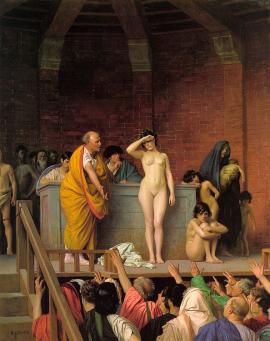
Intent can be a thicket. |
Consider the beauty of the Jewskin lampshade and then, this tobacco pouch.
There is an aesthetic phenomenon I have taken to calling "the Jewskin lamp." The name refers to the legendary (and no doubt real, not apocryphal) existence of lampshades made of the tanned skins of Jews (and Gypsies, truth be told, and who knows whose else?) from the German concentration camps of World War II. I use the lampshade example because it is easily recognized. I have actually seen the lampshade's American equivalent, a tobacco pouch made from the skin of an American Indian woman's breast. They exist, these artifacts; people want them, buy them, collect them. The aesthetic question is, "Can such an artifact be beautiful?"
The aesthete says it can. He goes further, sneering superciliously at my tedious moralizing (I envision Wilde, whose sneers were works of such artless, exquisite craft), and the aesthete asserts that its beauty and its provenance are completely separate issues. He asserts, moreover, that true art must ignore provenance entirely. The latter he asserts with what I dismiss, quite frankly, as hypocrisy, because in fact it is the decadent provenance of the art he champions that gives it appeal for him. These many years I have struggled to articulate and elaborate the traditional answer to the aesthetic question above, the non-aesthete's answer, an answer more on the order of "Yes but...." I finally realized that the true answer, quite simply, is "No, it cannot." The aesthete, to be blunt, is wrong.
The Dogma of Intrinsic Beauty
I don't subscribe to the dogma of "Platonic forms." Beauty does not inhere; it is a subjective response to an object, a response colored by all that does inhere: its materials, the artists's craft, the education we bring to the event of responding. Its provenance is as much a part of the object as is the thread that stitched the seams and the tune — should I happen to know it — that the creator hummed while working. And this is the reason the object in question, the Jewskin lamp, cannot be beautiful. It is not Beauty but the suffering and the evil intent, the violation of humanity, that are inherent in the Jewskin lamp. The problem rests in facts contiguous to the lamp's existence, facts that eliminate "Beauty" from our possible responses.
And no, I will not locate my judgment on suffering either, as much as it would be nice to have a reasonably objective locus to fall back on rather than the smoky substanceless reality of intention. When I view the expertly tanned and crafted tobacco pouch that cavalry officer prized, his souvenir of Sand Creek, it remains ugly whether the woman whose breast was skinned to provide material died instantly hours before the act, or watched as the flesh was peeled from her chest. Its ugliness inheres in the intention. Not even in the "honesty" (or lack of it) with which the intention is expressed. The tobacco pouch is redolent with honest, ingenuous hatred, as is the German bureaucrat's treasured lamp. (The "victorious" soldiers of Sand Creek exhibited their souvenirs, though perhaps not this one, at a public celebration in Denver a few days after, and the civilized people of Colorado joined in the general merrymaking.) Its ugliness inheres in what the existence of such an artifact tells us about the creator, the owner, and the admirer.
The leather used to create the lampshade is invested by its own history.
Fact and fiction, as Le Guin assures us, make all the difference. The leather used to create the lampshade is invested by its history. If we saw the lamp without knowing its history, it might seem beautiful and we would be tempted to add "in itself." But when its history is known, its beauty is destroyed — not just our perception of beauty, but the beauty itself which only exists, after all, as a perception, a transaction, a judgment. If the leatherworker did not know he was working with a bit of human skin (not possible in the case of the tobacco pouch, which has a prominent nipple), then he — no, let's say "she" — she might invest the pouch with her own idea of beauty. And ignorant of the leather's origin, I might see that beauty with admiration. But once the fact is there, on the table, the source, the truth, then the beauty is gone, as mysteriously not there as the life of a smothered child.
What Are the Rights of the Virtual?
We are far afield of the rights of the virtual, but as we head back to my subject, I think you will see the reason for this meander. We think of rights as something we have. I want to argue that rights, like beauty, are transactions. The woman next door has a right that prevents me from committing acts of violence against her. But that right is meaningless if I choose to violate it and society chooses not to punish me for that violation. What good does her right do her then?
Rights are transactions. A society defines itself by the rights it defends, and every right has its equivalent, a kind of "anti-right" defined by absence, like anti-matter, jello molds, and photographic negatives. My imagined neighbor has the right to be safe from my sadism; I have the anti-right not to commit acts of violence against her. You can define a subset of her rights by printing the positive of my negative anti-rights. Where are the "rights" defined, then? Is the essence of a photograph defined by the negative without which it can only be copied, not created? Or is its essence in what we glibly call "itself," the positive we cannot create without that negative? I think it is the essential negative, not the print made from that negative. I think the essential things that matter, especially from the community's perspective as it focuses on protecting that woman from my violence rather than on protecting my "freedom of expression," are the negatives, the molds that we use to offer rights to our fellows.
Here is where we encounter the rights of the virtual, in these prints and castings, these essential negatives I am calling "anti-rights." What harm is there in the sadistic elements of the Poser community? What harm if men are using their wonderfully realistic Victorias as their private porn stars, their slaves, their victims? What harm is there in creative minds spending hours to design virtual devices of torture which they can share with others less talented? To draw for an example from a site dedicated to virtual sadism using 3D models, what is wrong with an animated picture of Lara Croft, a unique "Nude Raider," which depicts her tied to a table and being penetrated by a plunging device that vaguely resembles a nail-studded aluminum baseball bat?
What's Wrong with This Picture?
We have to assume that this question is meaningful, not merely rhetorical, crazy as that may sound, in order to continue the discussion. So explore that thought. If there is something wrong with that artifact, that image, what is it? The violence? The lack of consent? The nudity? Remove details until it is a picture that is "not wrong." As you do so, you will discover that the wrongness you are groping at does not reside in the details. There is nothing inherently "wrong" with pictures of nudity, restraint, and violence.
|
|
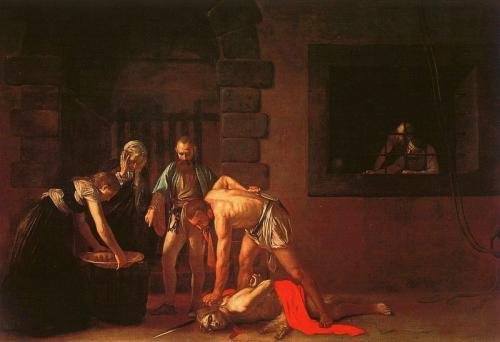
Where is the Evil? See the full-sized image of The Beheading of St. John the Baptist at Carol Gerten's Fine Art site, as well as Judith and Holofernes) and David with the Head of Goliath. (For which Caravaggio put his own face on Goliath's head and used his current lover as David. Find the intentions there....) Click on the image above to see the graphic depiction of John's severed head, the pool of blood repeated in the color and shape of the red cloak. |
And if there is "nothing" wrong with the picture of Lara Croft (however sadistic, it's just a picture of a 3D model, eh? Croft isn't even a real person, you know?), then add screaming. Still nothing wrong with it? Then add realistic gore spilling from the wound, increasing as the device does its work.
Nothing wrong with it?
Then replace the 3D model with a real woman. It's still just a movie, right? Great special effects. Nothing wrong with that. Finally, take the last step, and imagine that it is a documentary image of an actual torture. Nothing wrong with it still? Just watching a snuff film is not the same thing as committing a murder, after all. Is it? It's just images, you know?
Is it? I don't mean that to be a rhetorical question. At some point, there is something wrong with that picture of Lara Croft, and our obligation, as half of every transactional account that creates rights, as judges of ourselves if of no one else, is to know, as surely as we can, where that boundary lies.
The man who created that animation wanted to see Lara Croft being done to, and he did what he could to realize that vision. His wanting to see that image tells me something about his anti-rights, how his vision shapes the world, and I find him contemptible.
I did not want to see that image, I doubt if you are grateful that I have shared it with you, and I would like to forget it.
I did not want to see that image I've described, of the rape and murder of Lara Croft. I doubt if you are grateful that I have shared it with you, and I would like to forget it. Not because the picture told me an unwelcome truth about myself, in the way that horrible pictures of famine force me either to decide to act or to take responsibility for not acting. Not because I was forced to "discover" that I secretly shared this artist's vision, which I do not, not before nor after seeing it. The truth that men hate women — particularly assertive, independent women — is not one I need to be told, nor is it one I flinch from. I find the male fear of women pathetic, myself. But the "truth" here, the assertion intended, is that it is fun to act out that hatred. The hatred is Ok, and so is attacking the hated object. That "truth" is a lie, fact or not, that I spit on. It is his truth, the artist's, and therefore he is not to be trusted. He is a creature I would prefer not to know.
When we practice torture and slavery, the victim suffers most obviously, and that suffering is a truth separate from the victim's "intent" (I am thinking of masochism here). And the spectator suffers too; he becomes an actor in the scene, either an accomplice for his disinterest or a victim for his helplessness.
 
Shardik? Buy these books. Read them. If you can (I can't again; the experience is too terrible), read his third novel, The Plague Dogs, as well, and understand why sensible people object to using animals in research. Shardik, specifically, is a "heroic fantasy" in which the hero is a very non-heroic village hunter who becomes a king of Bekla and high priest of God. God is a great bear who roars through the civilization as a huge, crippled force of nature. And the death of Shara is the whole point, the lesson that the hunter Kelderek has sought since the bear rose before him on the bank of the Telhearna River. Shardik is available at Amazon.com. |
These are matters of intention, Adams' intention, and expressing the nature of that perceived intention is not easy. At the moment of the child's death, there is an audience of helpless onlookers, adults and children with circumstances so reduced tht they can do nothing, not even find the breath to protest, when Genshed attacks the girl Shara.
Adams means us to identify with their helplessness, their increasing sense that the evil Genshed serves is omnipotent, so that we, like two of his protagonists, must face a real moral choice when Genshed says, "Serve me, and I will reduce your suffering." Adams must depict monstrousness so we can talk about it. That is his intention, and it explains — even if it cannot excuse, for those damaged by the vision — the picture he puts in front of us.
And it is a risk, even such justified violence, because the perpetrator of torture, of brutality real or imagined, is diminished by his actions, touched by the contagion of the evil he feels he must handle for a higher end. He is not simply unmasked, revealed in his own evil, but he must remain surgeon not sadist. He may be innocent, but he is changed by acting out his grim imaginings, tainted by evil's touch regardless of his good intention. To imagine Genshed well, Adams must become Genshed, just as the creator of that Lara Croft nightmare had to "be" a person who would create it, regardless of his motives. That moment of imagination, I know from having done a similar act in my own fiction, is a terrible trial even if — perhaps especially if — it is an act of impersonation, incarnation, rather than a self-discovering flash, a revelation of true self.
The artist who uses torture as Adams does is a sin eater. When Adams wrote Genshed's brutality, describing the death of the girl Shara, he was eating sin for us. That is the role of the creative mind creating what it loathes: sin eater. He tasted the drug, the better to warn us away.
|
|
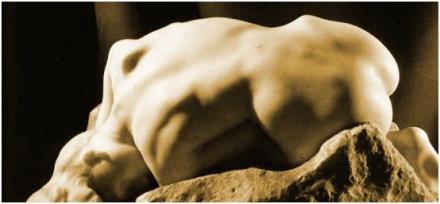
Where is the Intent? Apparent intent is not a necessary condition of great art. But when the intention is apparent, it becomes crucial. Were I to learn that Claudel found posing for this image humiliating or that Rodin abused her psychologically while creating it, the work would be defaced by that knowledge, as surely as a madman with a hammer defaced the Piéta some years ago. |
The creative mind risks the siren call of this freedom, this drug, and he may, like Tarantino, like Ellis and Dante, like others, find himself accepting Genshed's invitation, stepping into the mirror and embracing evil.
So yes, Mike and Vickie have rights. Posette and the P2 Mannequin have rights. Fictional characters have rights — Shara, Kelderek, even Genshed — and the creating mind is responsible when it resolves the conflict of those rights and the action of the imagination.
Adams sacrificed Shara's rights for what he perceived as the higher end of his moral fiction. The anonymous creator of the Lara Croft image violated her rights, and to what end? The virtual have rights, as surely as does the unmolded clay, the raw marble in the sculptor's intrusive hands. The blank sheet of paper I look at, deciding what to create, has rights. When I manifest violence, hatred, savagery, then the object I create has been invested with my evil. I may benefit, feeling a cathartic release, but that fact, my personal gratification, has no bearing on the evil now invested in an object that you, as hypocrite lecteur, must now deal with. You may savor the evil, the drug you sought, or you may learn something about the nature of evil from studying its ugly evidence. All matters of intent.
To propose a simple analogy: We rid ourselves of poisons, anti-gens, and life-threatening by-products through excretion, and we maintain healthy communities by understanding and dealing intelligently, knowledgeably, with the threat these self-expressions represent. Once the evil is expressed, it is not gone, just removed, eliminated, from our bodies. Good citizens bury their shit.
 |
 
|
